Thursday, 5 July 2012
A modern fairytale about books...
A friend of mine is writing the most exquisitely funny contemporary fairy tales which are, due to the pressure of her friends, now available for your enjoyment on her blog, Introvert Fairy Tales. I bring it to your attention at this point, because she has now written the ultimate book junkie fairy tale... Go look!!

Finding time to read...
This is my current TBR pile:
 It's growing rather faster than I can keep up with, and consequently, I'm not really keeping up with writing about the books either! However, bear with me - I just finished the two historical novels from the Marlow series that I mentioned in my Shakespeare post a little while back and I'm working on writing about them.
I thought the pile was worthy of a pic though, because, as will be very obvious from the titles, it is an excellent indication of my very eclectic reading style. The only thing that's missing to round it out is some children's literature - but that's because I just finished those two books!!
I have to make a start on the big book at the bottom - the plastic sleeves on top of it contain photocopies and print outs of articles about Chagall and his crucifixion paintings. This is research for a paper I'm delivering at the end of this month. I put the Dickens on the pile this morning because they glare at me from the bookcase. I promised myself that this year I would read them. They may be on the pile a while...! Anna Karenina is there because a British girl who writes the most wonderful blog, Book Snob, is reading it for the summer and invited me, along with anyone else who cared to, to join in and read it together. Since I haven't read it since I was about 16, I thought..why not? And then had to (had to...) go buy me a copy, because I haven't the faintest idea where mine has gone. In a different conversation with her, I complimented her on her reviews of Jane Austen's books - go have a look at her site, where you'll find her reviews listed in alphabetical order by author - and mentioned I'd not read mine for a while. Went to the bookcase to pick up Pride and Prejudice and, again, missing book... Too many house moves, I say. So, I had to get me a new copy of that as well. Sundry other titles in the pile kind of fell off the shelves and I had to catch them, rather than see them crash to the floor...and so the pile grew!
Trouble is, time being what it is, dealing with the TBR pile competes with the need to deal with the UFOs - those of you have other addictions than books may recognise this abbreviation, and no, it's not the expected one... It refers to 'unfinished objects' and the close relative of the TBR pile - 'the stash.' I have two large plastic crates that have been retrieved from storage, where they should never have been and they're actually two stashes. One of wool and the other of fabric. So, now there is knitting and sewing to fit in and around the reading - oh, and the little matter of working!
You all feel my pain, yes?!

I thought the pile was worthy of a pic though, because, as will be very obvious from the titles, it is an excellent indication of my very eclectic reading style. The only thing that's missing to round it out is some children's literature - but that's because I just finished those two books!!
I have to make a start on the big book at the bottom - the plastic sleeves on top of it contain photocopies and print outs of articles about Chagall and his crucifixion paintings. This is research for a paper I'm delivering at the end of this month. I put the Dickens on the pile this morning because they glare at me from the bookcase. I promised myself that this year I would read them. They may be on the pile a while...! Anna Karenina is there because a British girl who writes the most wonderful blog, Book Snob, is reading it for the summer and invited me, along with anyone else who cared to, to join in and read it together. Since I haven't read it since I was about 16, I thought..why not? And then had to (had to...) go buy me a copy, because I haven't the faintest idea where mine has gone. In a different conversation with her, I complimented her on her reviews of Jane Austen's books - go have a look at her site, where you'll find her reviews listed in alphabetical order by author - and mentioned I'd not read mine for a while. Went to the bookcase to pick up Pride and Prejudice and, again, missing book... Too many house moves, I say. So, I had to get me a new copy of that as well. Sundry other titles in the pile kind of fell off the shelves and I had to catch them, rather than see them crash to the floor...and so the pile grew!
Trouble is, time being what it is, dealing with the TBR pile competes with the need to deal with the UFOs - those of you have other addictions than books may recognise this abbreviation, and no, it's not the expected one... It refers to 'unfinished objects' and the close relative of the TBR pile - 'the stash.' I have two large plastic crates that have been retrieved from storage, where they should never have been and they're actually two stashes. One of wool and the other of fabric. So, now there is knitting and sewing to fit in and around the reading - oh, and the little matter of working!
You all feel my pain, yes?!
Wednesday, 4 July 2012
Bookkeeper...AKA book junkie!
It's been hectic - I have two books read awaiting some writing, but so far haven't had a chance to manage a long enough non-work computer session. However, in the meantime, for your amusement, this lovely little cartoon from a friend's Facebook page - where would we be without Facebook...scary thought...!


Is this you?
Saturday, 30 June 2012
Who doesn't love Mr Darcy?
Just a little extra-curricular post - ostensibly, I'm working. However, one of my friends posted this on Facebook last night, and it tickled my funnybone. For general amusement, and comments if any of you so please, I give you Mr Darcy:
 Personally, I think it works on a number of different levels - not that it's necessary to get into lots of analysis. But it made me smile, and I hope it does for all of you!

Friday, 29 June 2012
Shakespeare's world portrayed by others
One of my fellow book bloggers, Peter, has been reading Shakespeare's The Taming of the Shrew for an upcoming book club meeting. First off, he had to go get himself a copy of the play, and agonised about whether to get it in the original, or one of the many versions created especially for study purposes. In the end, he bought one of each - the latter being a contemporary 'translation' of the original Elizabethan English. You can read his post and the accompanying comments here.
As any of my regular readers will be well aware, my brain is a madly tangental beast, and while I'm currently embroiled in a couple of different Shakespeare plays, courtesy of my students, Peter's post didn't send me straight to Shakespeare, but more to the issues of reading him, and the discussions people have as a result. I'm working with sixteen year old boys and to date, we've covered Macbeth, King Henry, and Othello. My kids did Richard the Third and Macbeth. I often wonder why it's mostly the histories that are used as school texts when the comedies are so accessible - and that's coming more from the point of being someone who does read and enjoy Shakespeare plays. I had the good fortune to be taught by a lover of the Bard when I was at school, and she was able to imbue in me - if not the others in my classes - a love of the language, rather than the fear and loathing that seems to be so much part of many people's high school experiences. I've also been lucky enough to see a good many very clever live productions. The more recent movie versions of many of the plays have much to recommend them as well. In addition to that, because of my singing background, I've sung in two of the three Shakespeare-based Verdi operas and have seen the third - Otello, Macbeth and Falstaff respectively (the latter being based on The Merry Wives of Windsor).
However, it was two things that really got me hooked on the plays - firstly, the comedies, none of which I'd read (although I've rectified that since), so my first exposure to them was in the theatre. I saw, in close succession, A Midsummer Night's Dream and Twelfth Night as modern productions and was both entranced and in stitches - particularly with Twelfth Night. I saw a wonderful production of The Taming of the Shrew in Canberra with a company of all male actors, as in Shakespeare's day, so the female parts were all in drag and it was just priceless. When I sang in Macbeth, it was on the school syllabus, so the opera company collaborated with a local theatre company to do a combined schools production on our set. We did bits of the opera - which was a very traditional setting - while the theatre company created a kind of Reader's Digest version of the entire play with mixed gender casting and a very modern interpretation of costuming and style. I sang Third Witch, and I'll never forget arriving for the first full dress rehearsal with the two other opera witches and coming face to face with the three witches from the theatre company. We were drab, ragged 10th century crones with great wooden staffs, and they were mad psychedelic Disney crossed with Witches of Eastwick! I'm not sure which of us was more stunned - we thought they were amazing and they thought we were awesome!
The other layer to my Shakespeare experience is less straightforward, and I dare say, much more obscure, and probably not common to most of my readers - unless they're YA fans with a predilection for English boarding school books, AND have discovered Antonia Forest's Marlow books... This post is by way of introducing Antonia Forest, as I'm about to re-read the pair of historical novels that she wrote alongside the main series, and I know that when I've done that I'll end up re-reading the main series again, because I love them. Look carefully upon the covers, folks, because they are the one and only edition ever to go to print and getting hold of them was a protracted and expensive business!
 They're set in Shakespeare's time, beginning in the English countryside with the central character, Nicholas (an ancestor of the family in the modern series), running away from his brother's home after being expelled from school. Picked up by Kit Marlowe (a contemporary of Shakespeare's) who offers to pass him off as a cousin, he is whisked away in the night. As things come to pass, Kit is killed in a drunken brawl, and Nicholas is conveyed to London by Robin Poley, who drops him at the walls of the estate of the Earl of Southampton - Kit Marlowe's patron - to convey the news of Kit's death. However, Poley is a government spy and blackmails Nicholas, telling him he is to communicate anything 'useful' to the government's cause to him, or risk his life... When Nicholas is offered a place in the Earl's household, where he has been met with kindness, he refuses, knowing that he represents a threat to them and himself if he remains there. In due course, having discovered the boy possesses both a fine voice and a prodigious ability to memorise anything on one sighting, the Earl finds him a place with his other poet...the other poet being none other than Will Shakespeare.
The books cover a period of turbulent politics, during which the theatres were controlled by the government and plays were heavily vetted for possible treasonable content prior to being played. It includes the building of the Globe Theatre, and creates a wonderfully rich, beautifully researched - although fictionalised - account of the life of the company behind the plays. If you've read any histories of London of that time, you will recognise the scholarship in Forest's research. They are a wonderful read - for children and adults alike. This is one of the stand out features of this entire series - the modern books as well. Forest is a writer with a rare talent for elegant, witty prose that is, beyond any other characteristic, entirely believable. She has an outstanding ability to write wonderfully pithy dialogue that never fails to engage me, and there are particular conversations between characters that, despite man, many readings, still make me laugh and prompt me to read them out loud to whoever is in the vicinity.
What she does with these two books, is bring Shakepeare's world alive and makes it real. The boys play the young women in his plays, and we get an inside look at the gender politics of the time that forbade women to appear on stage. Older women are played by the adults in the company. As it is a small group, people usually have to play more than one character in any given play - and you can just imagine Shakespeare pondering the logistics of characters exiting and entering as he wrote, having to take into account who was playing who and how long they'd have to change costumes in between. There is also the ever present issue of the boys themselves and how long Shakespeare had with any of them before their voices broke and they could no longer play women. This is also the time of Richard Burbage, the first to play any of Shakespeare's heroes, and revered in all the histories that mention him as the greatest actor of his time.
Part of the charm of these books for me is that, like the movie Shakespeare in Love, we are afforded, via the gifts of clever writers, a glimpse of how it might have been in Shakespeare's time. It brings to mind that quote I used in my previous post from one of John Wyndham's stories about time travel - wouldn't you just love the opportunity to see the premier of a Shakespeare play, in The Globe, on the day, with the Bard himself in the cast - because he was a player himself before he started writing his own plays? If it were possible, then there would be the choice to make of where to sit - would one want to be among the groundlings, below the stage but close to the action, or up in the stands with the well to do? All I know is that my readings and other experiences of the plays are now coloured by the images I carry from these books, and others that do similar things. However, these are about as good as it's possible to get...
As any of my regular readers will be well aware, my brain is a madly tangental beast, and while I'm currently embroiled in a couple of different Shakespeare plays, courtesy of my students, Peter's post didn't send me straight to Shakespeare, but more to the issues of reading him, and the discussions people have as a result. I'm working with sixteen year old boys and to date, we've covered Macbeth, King Henry, and Othello. My kids did Richard the Third and Macbeth. I often wonder why it's mostly the histories that are used as school texts when the comedies are so accessible - and that's coming more from the point of being someone who does read and enjoy Shakespeare plays. I had the good fortune to be taught by a lover of the Bard when I was at school, and she was able to imbue in me - if not the others in my classes - a love of the language, rather than the fear and loathing that seems to be so much part of many people's high school experiences. I've also been lucky enough to see a good many very clever live productions. The more recent movie versions of many of the plays have much to recommend them as well. In addition to that, because of my singing background, I've sung in two of the three Shakespeare-based Verdi operas and have seen the third - Otello, Macbeth and Falstaff respectively (the latter being based on The Merry Wives of Windsor).
However, it was two things that really got me hooked on the plays - firstly, the comedies, none of which I'd read (although I've rectified that since), so my first exposure to them was in the theatre. I saw, in close succession, A Midsummer Night's Dream and Twelfth Night as modern productions and was both entranced and in stitches - particularly with Twelfth Night. I saw a wonderful production of The Taming of the Shrew in Canberra with a company of all male actors, as in Shakespeare's day, so the female parts were all in drag and it was just priceless. When I sang in Macbeth, it was on the school syllabus, so the opera company collaborated with a local theatre company to do a combined schools production on our set. We did bits of the opera - which was a very traditional setting - while the theatre company created a kind of Reader's Digest version of the entire play with mixed gender casting and a very modern interpretation of costuming and style. I sang Third Witch, and I'll never forget arriving for the first full dress rehearsal with the two other opera witches and coming face to face with the three witches from the theatre company. We were drab, ragged 10th century crones with great wooden staffs, and they were mad psychedelic Disney crossed with Witches of Eastwick! I'm not sure which of us was more stunned - we thought they were amazing and they thought we were awesome!
The other layer to my Shakespeare experience is less straightforward, and I dare say, much more obscure, and probably not common to most of my readers - unless they're YA fans with a predilection for English boarding school books, AND have discovered Antonia Forest's Marlow books... This post is by way of introducing Antonia Forest, as I'm about to re-read the pair of historical novels that she wrote alongside the main series, and I know that when I've done that I'll end up re-reading the main series again, because I love them. Look carefully upon the covers, folks, because they are the one and only edition ever to go to print and getting hold of them was a protracted and expensive business!

The books cover a period of turbulent politics, during which the theatres were controlled by the government and plays were heavily vetted for possible treasonable content prior to being played. It includes the building of the Globe Theatre, and creates a wonderfully rich, beautifully researched - although fictionalised - account of the life of the company behind the plays. If you've read any histories of London of that time, you will recognise the scholarship in Forest's research. They are a wonderful read - for children and adults alike. This is one of the stand out features of this entire series - the modern books as well. Forest is a writer with a rare talent for elegant, witty prose that is, beyond any other characteristic, entirely believable. She has an outstanding ability to write wonderfully pithy dialogue that never fails to engage me, and there are particular conversations between characters that, despite man, many readings, still make me laugh and prompt me to read them out loud to whoever is in the vicinity.
What she does with these two books, is bring Shakepeare's world alive and makes it real. The boys play the young women in his plays, and we get an inside look at the gender politics of the time that forbade women to appear on stage. Older women are played by the adults in the company. As it is a small group, people usually have to play more than one character in any given play - and you can just imagine Shakespeare pondering the logistics of characters exiting and entering as he wrote, having to take into account who was playing who and how long they'd have to change costumes in between. There is also the ever present issue of the boys themselves and how long Shakespeare had with any of them before their voices broke and they could no longer play women. This is also the time of Richard Burbage, the first to play any of Shakespeare's heroes, and revered in all the histories that mention him as the greatest actor of his time.
Part of the charm of these books for me is that, like the movie Shakespeare in Love, we are afforded, via the gifts of clever writers, a glimpse of how it might have been in Shakespeare's time. It brings to mind that quote I used in my previous post from one of John Wyndham's stories about time travel - wouldn't you just love the opportunity to see the premier of a Shakespeare play, in The Globe, on the day, with the Bard himself in the cast - because he was a player himself before he started writing his own plays? If it were possible, then there would be the choice to make of where to sit - would one want to be among the groundlings, below the stage but close to the action, or up in the stands with the well to do? All I know is that my readings and other experiences of the plays are now coloured by the images I carry from these books, and others that do similar things. However, these are about as good as it's possible to get...
Thursday, 28 June 2012
Book junkie heaven...

...well, a little slice of book junkie heaven! Finally, I made it to the post office box and in amongst the boring, windowed envelopes was a small padded bag with a handwritten address containing THIS! Peter, over at Kyusireader, eat your heart out...just look at my new treasure... As I said, after some hunting around eBay, I came across this copy of John Wyndham's The Seeds of Time, the anthology I've been missing for ages, and bought it. It's a 1962 Penguin edition with, huge bonus, a two page foreword by the man himself discussing the science fiction genre and positioning himself within it with this collection of short stories. They were written over a fifteen year period and he refers to them as 'experiments' with the genre, which opened up when,
Having collected my parcel and gloated over the contents briefly, I decided that the next bit of my morning could wait just a little while - long enough for me to read just one story - hence the accompanying photo! I started at the beginning with the first story, Chronoclasm, which deals with time travel and the potential consequences of interfering with history. The feelings that I think we all nurse about time travel are summed up beautiful by Tavia, the female lead, who has come to 1950s Britain from the twenty-second century,
Now I have to get on with my work for the day, but there are eight more stories to go yet....including the chilling Survival, which is the one I have the clearest memories of...again, another hanging ending, but with a very nasty twist.
...there came a time when certain editors [of magazines] grew mildly mutinous with the perception that the terms of reference did not truly restrict them to the adventures of galactic gangsters in space-opera, and they began, some by stealth, some by declaration, to encourage their authors to do a bit more exploration within the definition.Wyndham wraps up his foreword by thanking numerous un-met editors who, as he says '...encouraged me by printing one or more of these experiments on the theme: 'I wonder what might happen if...?'' Thank goodness they did, or we might not have his wonderful novels.
Having collected my parcel and gloated over the contents briefly, I decided that the next bit of my morning could wait just a little while - long enough for me to read just one story - hence the accompanying photo! I started at the beginning with the first story, Chronoclasm, which deals with time travel and the potential consequences of interfering with history. The feelings that I think we all nurse about time travel are summed up beautiful by Tavia, the female lead, who has come to 1950s Britain from the twenty-second century,
...all the things one could do! Fancy being at the first night of a new Shaw play, or a new Coward play, in a real theatre! Or getting a brand-new T.S. Eliot on publishing day. Or seeing the Queen drive by to open Parliament. A wonderful, thrilling time!It's a delightful, bittersweet story that leaves the reader hanging at the end, wishing there was more - that tantilising thing about short stories! I got all my errands done and came home to crash with tea and the second story, Time to Rest. It's a different beast; the story of the remnants of the human race, all men, marooned on Mars following the end of Earth's existence. The central character, Bert, was on the last ship that left Earth, and with his fellow crew watched the Earth split open and self destruct. By a mixture of guess work and navigation through a changing space, they make it to Mars, where they're slowly joined by others coming back from different exploratory journeys, to end their days on the red planet. It's a sombre, bleak little story - one that I don't think I'd manage if it were a full length book.
Now I have to get on with my work for the day, but there are eight more stories to go yet....including the chilling Survival, which is the one I have the clearest memories of...again, another hanging ending, but with a very nasty twist.
Monday, 25 June 2012
Beyond Chocolat
The joy of finding a new author to explore is never to be underestimated. I had a conversation recently with my BFF about Joanne Harris' books in the wake of my haphazard acquisition of the Chocolat trilogy, and she'd bought the latest of the three on the basis of it being written by Harris without being particularly aware of the connection - because she's bought all of Harris' books since Chocolat. And here's me just discovering them! That's OK, we've had similar conversations in reverse - one of them in the last few weeks actually, because somehow L.M. Montgomery's 'Anne' books had eluded her until now, so she's been on a voyage of discovery with those.
I loved Chocolat - as I said in my post about it, which you can read here if you haven't already. Apart from the fact that Harris is a writer with a wonderful talent for telling a story, there is a glorious element of play. It gives the book, despite some of the darker elements, a sense of innocence at times that is most beguiling. Moving onto the next stage of Vianne and Anouk's lives, that innocence is absent.
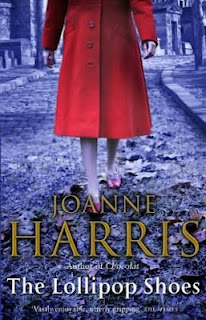 Lollipop Shoes takes place four years in Paris, after they leave Lasquenet. They have, once again, changed their names, Vianne is Yanne, and Anouk has become Annie. They have become three, with the birth of Rosette, Roux's daughter - although, that is not information Vianne has shared with anyone. The events surrounding their flight from Lasquenet, Rosette's birth, and subsequent arrival in Paris are hinted at, little bits here and there, enough to tantalise but not to make clear why it is that Vianne is just barely scraping a living in a tiny patisserie in Montmartre, Anouk is distant with gathering adolescent storm clouds and there is none of the lighthearted staring down of life's challenges that characterised them in Chocolat.
Instead of living the truth they lived before Rosette's birth, Vianne is trying to create a life that is 'normal'. Rosette was a sickly baby who did not thrive. Even now, she is much smaller than usual for her almost four years and she doesn't speak. She does however, have an imaginary friend, Bam, as Anouk did with Pantoufle. We find Vianne and the girls at a turning point. Their landlady, and partner in the business, has just died. The owner of the building, Thierry, is away on business can can't be at the funeral, but sends a message to say that they're not to worry, something can be worked out. At the same time, a mysterious stranger arrives, Zozie de l'Alba - quirky, loud, confident, charming and, above all, helpful.
This is indicative of the tone of this book - everything feels as if it's a back story. There was a direct quality to the story-telling in Chocolat. Lollipop Shoes is full of hidden messages, secrets, half-truths, and layers of mystery. No-one is quite what they appear to be - we know that Vianne is not being herself, and as a result, Anouk is being stifled. Thierry appears to be the consummate good guy, helpful when things need to be done and outwardly supportive of Vianne and the girls - in reality, he is a control freak; someone who, as long as he is in charge, can be magnanimous and caring. Zozie, who arrives on the wind - something Vianne is aware of but refuses to acknowledge - has an agenda, and her story emerges as a parallel narrative. Piece by piece, almost sitting in the same position as Vianne, we are allowed in to see Zozie's subtle, clever invasion of Vianne's little family, motivated by her desire to get hold of Anouk, Anouk who has great powers, although they are being stifled, like Vianne's, due to fear. Zozie encourages Vianne to go back to making chocolate, instead of the basic patisserie fare she's been struggling to make financially viable and slowly, the magic begins to have its effect on the surrounding community as it did back in Lasquenet.
When Roux arrives unexpectedly in Paris, Vianne's composure and careful construct is shattered. Unbeknown to her, he had sent a postcard to let her know he was coming - a postcard appropriated by Zozie. Now, in the mix of people working hard to preserve various facades, there are two who don't - because they can't - Roux and small Rosette.
There is darkness and real evil in this book, and for the first time, the nature of the magic that was just an undercurrent in Chocolat is spelled out. Zozie represents all that can be misused with witchcraft, while Vianne, Anouk and Rosette are crafted from very different cloth. Ultimately, the climax of the novel is an elemental struggle of good and evil, with some unexpected results.
 Peaches for Monsieur le Cure takes us four years on again - I don't know if this was planned or not. Vianne, having reverted to her original name, and the girls are living with Roux on a houseboat moored on the Siene, still in Paris. Roux has built for them a compromise - from the houseboat, Vianne runs a small chocolaterie, Roux picks up odd jobs, Anouk is in school and Rosette is her inimitable, individual self - still not speaking much, but seeing... And then comes a letter from the dead - a letter from Armande, via her grandson Luc, telling her to return to Lasquenet, to pick the peaches from Armande's tree, to bring the girls, that there is a need for her in the village.
Lasquenet has changed, as have many areas of France, and this was a totally unexpected aspect of this third book. There is an air of the fairy-tale about these books, steeped as they are in magic and mystery, and to have that fairy-tale colour juxtaposed against the edgy politics of current multicultural issues in Europe was a bit jarring at first. Perhaps it's that while we see many of these issues played out in the news in big cities, we don't often get a picture of how the impact of the growth of Muslim communities within smaller towns and villages has been and continues to be.
Tensions in the village have grown way beyond those that Vianne experienced during her first time there. The Muslim community has grown, with many more people arriving from Tangier, and a mosque has been established in one of the old buildings. There are enormous tensions between the old villagers and the new community - but also, on each side of that schism, there are issues within the original village community, and within the Muslim community. In both, the original religious leaders are being usurped by younger, 'more progressive' men, and both the older leaders appear to be crumbling before the onslaught. People's perceptions of rights and wrongs within their own groups and across the cultural divide are being coloured by deeply held prejudices and fears. Vianne finds that while some people welcome her back, others view her with deep suspicion. She begins to question why she came, why she took Armande's letter so to heart, and why she ever thought she could do anything for anyone. It is the same insecurities that wracked her in Lollipop Shoes, reawakened when it seems that her powers are required, and those of her children are coming alive again in an environment they both love.
In one poignant paragraph, everything she has ever wanted but never allowed herself to acknowledge or - more importantly - really have, is summed up so perfectly. Well, I thought it was, but perhaps that speaks of my own yearnings, unwilling gypsy child that I am:
There are many small and large dramas played out in the narrative. She is involved in some directly, in others she is the catalyst, and in some she is more of a bystander. But they all touch her, and they all contribute to her understanding of herself.
These are exquisitely written books. I have been quite unwell for some weeks, and this past weekend was spent mostly on the couch. It was timely, perhaps, that I had new books, but I have to say, these weren't just any new books. As I said at the beginning of this post, finding a new author is something special. I have a whole new treasure chest of stories awaiting me from Joanne Harris, and if you've never read any of her books, I suggest you get ye hence to your local bookstore and add them to your collection!
I loved Chocolat - as I said in my post about it, which you can read here if you haven't already. Apart from the fact that Harris is a writer with a wonderful talent for telling a story, there is a glorious element of play. It gives the book, despite some of the darker elements, a sense of innocence at times that is most beguiling. Moving onto the next stage of Vianne and Anouk's lives, that innocence is absent.
Instead of living the truth they lived before Rosette's birth, Vianne is trying to create a life that is 'normal'. Rosette was a sickly baby who did not thrive. Even now, she is much smaller than usual for her almost four years and she doesn't speak. She does however, have an imaginary friend, Bam, as Anouk did with Pantoufle. We find Vianne and the girls at a turning point. Their landlady, and partner in the business, has just died. The owner of the building, Thierry, is away on business can can't be at the funeral, but sends a message to say that they're not to worry, something can be worked out. At the same time, a mysterious stranger arrives, Zozie de l'Alba - quirky, loud, confident, charming and, above all, helpful.
This is indicative of the tone of this book - everything feels as if it's a back story. There was a direct quality to the story-telling in Chocolat. Lollipop Shoes is full of hidden messages, secrets, half-truths, and layers of mystery. No-one is quite what they appear to be - we know that Vianne is not being herself, and as a result, Anouk is being stifled. Thierry appears to be the consummate good guy, helpful when things need to be done and outwardly supportive of Vianne and the girls - in reality, he is a control freak; someone who, as long as he is in charge, can be magnanimous and caring. Zozie, who arrives on the wind - something Vianne is aware of but refuses to acknowledge - has an agenda, and her story emerges as a parallel narrative. Piece by piece, almost sitting in the same position as Vianne, we are allowed in to see Zozie's subtle, clever invasion of Vianne's little family, motivated by her desire to get hold of Anouk, Anouk who has great powers, although they are being stifled, like Vianne's, due to fear. Zozie encourages Vianne to go back to making chocolate, instead of the basic patisserie fare she's been struggling to make financially viable and slowly, the magic begins to have its effect on the surrounding community as it did back in Lasquenet.
When Roux arrives unexpectedly in Paris, Vianne's composure and careful construct is shattered. Unbeknown to her, he had sent a postcard to let her know he was coming - a postcard appropriated by Zozie. Now, in the mix of people working hard to preserve various facades, there are two who don't - because they can't - Roux and small Rosette.
There is darkness and real evil in this book, and for the first time, the nature of the magic that was just an undercurrent in Chocolat is spelled out. Zozie represents all that can be misused with witchcraft, while Vianne, Anouk and Rosette are crafted from very different cloth. Ultimately, the climax of the novel is an elemental struggle of good and evil, with some unexpected results.
Lasquenet has changed, as have many areas of France, and this was a totally unexpected aspect of this third book. There is an air of the fairy-tale about these books, steeped as they are in magic and mystery, and to have that fairy-tale colour juxtaposed against the edgy politics of current multicultural issues in Europe was a bit jarring at first. Perhaps it's that while we see many of these issues played out in the news in big cities, we don't often get a picture of how the impact of the growth of Muslim communities within smaller towns and villages has been and continues to be.
In one poignant paragraph, everything she has ever wanted but never allowed herself to acknowledge or - more importantly - really have, is summed up so perfectly. Well, I thought it was, but perhaps that speaks of my own yearnings, unwilling gypsy child that I am:
There's something very comforting about the ritual of jam-making. It speaks of cellars filled with preserves; of neat rows of jars on pantry shelves. It speaks of winter mornings and bowls of choclat au lait, with thick slices of food fresh bread and last year's peach jam, like a promise of sunshine at the darkest point of the year. It speaks of four stone walls, a roof, and of seasons that turn in the same place, in the same way, year after year, with sweet familiarity. It is the taste of home.Ultimately, Vianne's journey back to Lasquenet is a means of coming to terms with herself, with who she is, with what she is. It is a means of coming to an acceptance of what her children have inherited and that she must allow them to be who they are. It is when she learns that she needs to be able to trust the people close to her, and let them in.
There are many small and large dramas played out in the narrative. She is involved in some directly, in others she is the catalyst, and in some she is more of a bystander. But they all touch her, and they all contribute to her understanding of herself.
These are exquisitely written books. I have been quite unwell for some weeks, and this past weekend was spent mostly on the couch. It was timely, perhaps, that I had new books, but I have to say, these weren't just any new books. As I said at the beginning of this post, finding a new author is something special. I have a whole new treasure chest of stories awaiting me from Joanne Harris, and if you've never read any of her books, I suggest you get ye hence to your local bookstore and add them to your collection!
Subscribe to:
Posts (Atom)