Translate

Saturday, 19 December 2015

Tiny Books #6 - The Owl and the Pussycat

When I started the Tiny Books series, I had this book at the back of my mind. A couple of times since starting the posts, I've looked for it and couldn't find it, search though I might. Somewhere along the line I think my copy must have joined the books that have disappeared during various moves. And then came my cousin's de-clutter and the two boxes of books that subsequently came to live with me... Lo and behold, she also had a copy of this, and didn't want it.

I don't remember when I first got my copy - probably it was given to me as a small child. I have a faint memory of an inscription, but without the actual book, I can't verify that. My cousin's lacks an inscription, so it certainly wasn't a gift from my mother, as she ALWAYS wrote in gift books, so I have no idea as to the origins of this copy.

However, it is still the absolute gem I remember, both from my childhood and later one when I read it to both my children. Edward Lear wrote such lovely whimsical poems, and this would have to be my absolute favourite I think...

It was one of a series published by Whitman called the Tiny Tot Tales. This copy was printed in 1968 - I have no idea if it was a single run or whether there were reprints. It's a hard cover, measuring 10.5cm x 14cm. It's not a board book, it's a legitimate hardcover, but the pages are very sturdy paper. It's well out of print, but I did find three copies on Amazon.

The illustrations are by Bonnie and Bill Rutherford, and I've always loved the rich colours and simple, but not cartoon-y, style of the four animals - not forgetting the Piggy with his ring and Turkey who marries the Owl and the Pussycat!
For anyone who wants to enjoy The Owl and the Pussycat in quite another marvelous way, go have a listen to this:

Monday, 30 November 2015

Tiny Books #5 - Lilliput Aboriginal Words of Australia

My cousin has been decluttering recently, and as a result, I scored two cartons of books! Then she turned up last week with this little gem that she'd found in another box of bits and pieces:
Published by A.H. & A.W. Reed, NZ, in 1966, it was the second such publication, the first being a similar dictionary of Maori words (1962). They both followed original publications of cloth bound, regular sized editions. This is the first edition of the Lilliput version. A quick online search yielded that there is one copy of it in each of the National Library of Australia, the State Library of NSW, the State Library of Western Australia, and the Library of the University of Queensland. As well, there is one available for sale with Abe Books, and several of the Maori edition with various booksellers around the world. 
 
It has soft vinyl covers, plain end papers, and beautifully detailed illustrations. It's arranged as most foreign language dictionaries are with both English/Aboriginal and Aboriginal/English sections. It also makes a point of acknowledging, in the foreword, that it is a tiny sampling of Australian Indigenous vocabulary. There were some 250 country groups of Indigenous Australians, prior to white settlement in the late 18th century. They all had their own languages and cultural practices, with proximity and/or distance playing an enormous role in how disparate they could be. 
Photo courtesy of the ABC showing locations of different country groups

The book measures 39mm x 49mm. The photo below, with an Australian 20 cent coin will give some sense of size comparison:
The other reason my cousin felt I'd like to have it, apart from my book junkie tendencies, is that it was a gift from my brother and I to her father, our uncle, for his birthday in 1967, and has an inscription written in my mother's beautiful script.
We were three and a half and two and a half at the time, and I'm sure, knowing my mother, that there'd have been a sense of the fitness about two tiny children giving such a tiny book as his birthday gift. He was also a bit of a book junkie - it runs in the family, so I had no hope at all, really. Many of the books I've acquired from this declutter carry my mother's inscriptions, because she was THAT sister and aunt, who gave books, much as I have been. There's even one with an inscription from me, a gift for my uncle! 

This is quite a little treasure to add to my collection of tiny books, and has provided much enjoyment already. As DB is a Kiwi, I can see I'm going to have to follow up the Abe Book lead and get a copy of the Maori one as well....


Thursday, 26 November 2015

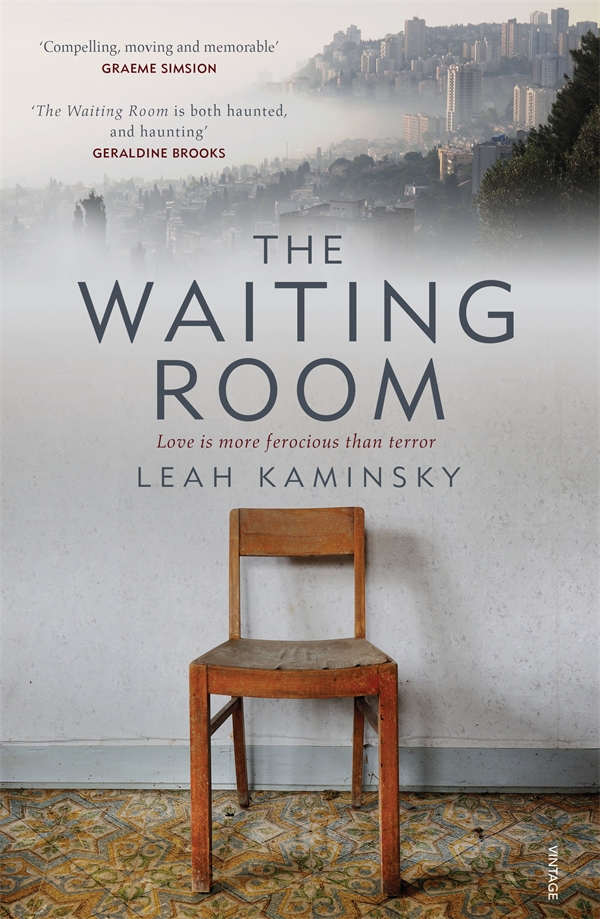
The Waiting Room - Leah Kaminsky

Without actually trying to, I've managed a succession of Holocaust novels in my latest lot of new books. There seems to be a new 'flavour' in them of late, and I don't know if that's due to where we are in history now, with fewer and fewer Holocaust Survivors still alive, or some other factor.
The Waiting Room, by Leah Kaminsky, is definitely a bird of a different feather. It tells the story of a child of Holocaust Survivors. Australia took the largest number of Survivors per capita than any country other than Israel, after the war. Both Sydney and Melbourne had very large numbers within the Jewish communities, with others scattered throughout the smaller communities in other capital cities and smaller towns. 

Life for the children of Survivors was often fraught, many of them growing up without really knowing what had happened to their parents. They were haunted, nevertheless, by the nightmares and horrific memories that affected everyday behavior of the Survivors for the rest of their lives. In my experience with Survivors, there were those who told their stories, and those who didn't. Many who did were prompted by one of two motives - either to honour those of their families they had lost, and/or to teach others what happened in an effort to ensure it could never happen again. What they had with those Survivors who didn't tell their stories publicly, was that many of them had rarely shared their stories directly with their children. Occasionally, they'd tell their grandchildren, but not their children. When asked why not, they used to say that they didn't want their children knowing and being hurt by the stories - or that they didn't want to relive it within their families. Often, it was many years after the events before they started recounting their stories in public, and for those bearing testimony, it was frequently to school aged children in museums or schools, learning the history. That made a certain level of logical sense to me, then, thinking about them deciding to pass the stories on to their grandchildren. 

Dina is an Australian doctor living and working in Haifa, married to Eitan, an Israeli. She met him while travelling, on an unplanned visit to Israel after a medical conference in Europe. They marry, and have a son, Shlomi. As the story begins,  Shlomi is six and she is heavily pregnant with their second child. Eitan proves to be what previous boyfriends and lovers in the past have failed; able to live with the ghosts she carries with her from her parents' past. 

She grew up in Melbourne, the only child of parents who both survived the camps in Europe. Her father was in Auschwitz, having lost his wife and daughter before being deported. None of his extended family survived. Her mother was in Bergen Belsen, and was the only survivor from her family. They met in a DP (Displaced Person's) Camp, and married when they got visas for Australia. Dina's father is a quiet man, a tailor, who never speaks of his previous family. However, her mother, who keeps photos of that first wife and child, cannot stop herself relating countless tales of the horrors she endured, and stories from other Survivor friends. From Dina's earliest days, there are periods when her mother is admitted to hospital, and to add to her mother's ghosts are mysterious things like 'shock treatment' and endless absences that are explained to her as her mother needing 'a little rest'. 

Dina's father dies from a massive heart attack, and she is left caring for her increasingly fragile mother who, eventually, commits suicide by overdosing when Dina is eighteen. After qualifying as a doctor she attempts to escape the past by travelling and falling in and out of short term relationships. Eitan, a sabra (native born Israeli) who grew up on a traditional kibbutz, is a surprise to her. Exotic, calm, persistent, he holds her when she cries, and asks to be introduced to her ghosts, eventually convincing her to marry him. They choose Haifa over other Israeli cities to settle, on the basis that it is 'safer' than Jerusalem, Tel Aviv or Beersheva where there are all too frequent terrorist attacks. 
 
However, the time is the second intifada, and attacks by suicide bombers are more frequent and widespread. Pregnant and vulnerable, Dina begins to obsess about Shlomi's safety, and the ghost of her mother, particularly, becomes more persistent, castigating her for flying off the handle and wanting to leave and go back to Australia where it's safer, telling her that her place is in Israel with her husband, because NOWHERE is safe for Jews. Eitan is struggling with the distance that is growing between them and continues to tell her that Shlomi will only become anxious if he sees her being anxious and overly protective of him. Having grown up in Israel, he is more pragmatic about the risks and understands the need to go on living as normally as possible. Dina is unable to find a similar pragmatism.

The book is, essentially, a story of one woman's struggle to reconcile the fears of the past and those of her present. She finds herself talking back to her mother's ghost while in the middle of other conversations with actual people as her mother's presence begins to dominate more and more as her own stress levels rise. In real time, the story is a tale of a single day when there is a terror warning for Haifa, and Dina ricochets between her surgery, Shlomi's school, the local shuk, and back to the surgery. It is her very panic and inability to stay in one place that ultimately saves her from dying in the attack, as she doesn't make it back to the surgery in time to be inside the building when the bomb is detonated. Instead, she is out by her car, knocked down by the blast and witnessing everything.

At a time when, once again, Israelis going about their everyday lives are being threatened by lone wolf attacks from Palestinian terrorists, this book is chilling. My friends in Israel are living the fears, stresses and anxiety that Dina goes through in that one day. They don't necessarily have the ghosts of Survivor parents haunting them. However, many must have ghosts of friends and family lost in both intifadas. When I was there in 2008, it was a calm period. But one of the Australian in my group studying at Yad Vashem took us one evening to a Jerusalem restaurant for dinner. A restaurant that had been rebuilt after it had been blown up during the second intifada, killing many innocent people, including friends of his. There is a memorial plaque at the entrance with a list of the names of the dead. He wanted to take us there; he always goes when in Jerusalem. 

Although, at the end of the book, Dina goes back to Melbourne with her son and newly born daughter (named after her father's first child), she knows she will go back to Haifa. She knows that the way forward is to be tenacious and grab onto life in Israel with Eitan. My friend goes back to that restaurant to eat for the same reason, and in honour of his friends.

Saturday, 21 November 2015

The Book of Aaron - Jim Shepard

I've read some tough Holocaust books - both fact and fiction - but I have to say, Jim Shepard's The Book of Aaron is right up there with the toughest.
Set in the Warsaw Ghetto, the book begins as the walls to shut the Jews in from the rest of the city are being built. Nine year old Aaron's family lives within the area that is being enclosed, having previously moved from the country when his father was offered work in a Warsaw factory. The family is often at odds with each other, relationships are brittle and frequently acrimonious. Aaron is nicknamed Sh'maya (a play on the Hebrew 'sh'ma' - 'hear') by an uncle who says he 'did so many things that made him put his finger to his nose as a warning and say, 'God has heard.''. He doesn't like school and comes home with unsatisfactory on all his reports. His parents are constantly frustrated with him, but are mostly unable to convince him of the benefits of knuckling down. He seems to deliberately continue to provoke them by getting into more trouble - almost as if any attention is going to be good attention, even being in trouble.

As more and more people are moved into the Ghetto and daily live gets more and more difficult, Aaron teams up with a gang of other children smuggling food via tunnels in the walls. It is dangerous, and often they fluke escaping the authorities - German, Polish and Jewish. His gang is as dysfunctional as his family, constantly sniping at one another and inflicting punishments on each other. Aaron is often the butt of their fears and frustration of their collective circumstances, as he is frequently unsure of himself and cries enough to aggravate them. 

Uncertainty is the norm for everyone in the Ghetto as, first, men and older boys are rounded up and taken off to 'work details', and then deportations to the death camps begin. Disease starts to take its toll. First Aaron's younger brother dies. Then his father and older brothers disappear in a 'work' roundup. Through a contact within the Ghetto's Jewish police, he manages, in exchange for intelligence of underground activities, to get occasional word of them. Eventually that dries up, but he is now caught up in having to make reports to his police contact. Then his mother dies of typhus and he is left alone. 

When he and a fellow gang member, Lutek, are caught, Lutek is shot, but he is let off - no doubt to take word of potential consequences back to his gang, and others like them. The rest of the gang no longer trust him and he is left with no one to turn to. Having had a number of chance encounters with Janusz Korczak, director of an orphanage for Jewish children, he seeks refuge there, and begins a strange relationship with Kosczak - part colleague, part protege, part protector. 

Janusz Korczak was a world renowned pediatrician, writer and educator. When the Ghetto walls were erected, he received countless offers to be rescued, hidden, looked after. He refused them all, because he wouldn't leave the children. One of the legendary figures of the Holocaust, he was transported, along with all the children and orphanage staff, to the death camp, Treblinka, where they were gassed on arrival. 

The narrative of the novel creates a picture of those last weeks in the Ghetto within the orphanage before they were ordered to the trains to be deported. Most of what I've read of Korczak paints a noble portrait of a sensitive, self-sacrificing, intelligent man, who devotes his life to children and their welfare. Shepard offers up a portrayal that shows us a man down to his last resources, worn out begging for food and money for the children, ill with malnutrition and a heart condition, despondent and depressed. He smokes too much, drinks too much, doesn't sleep enough, and smells bad. He is often frustrated and angry, but never with the children. Aaron shadows him trying, along with orphanage staff, to discourage him from going out as it gets more and more dangerous. Aaron, in turn, is terrified of going out, fearing retribution from those gang members still alive, and of being picked up again by the authorities. 

Ultimately, the order comes for the orphanage to be deported. In the chaos of the Umschlagplatz - the square where the Jews were gathered before being put on the trains - their arrival in neat, orderly lines, four abreast, with Korczak leading them, is one of the most poignant scenes reported. The novel ends as Koczak is lifting the smallest children into the cattle trucks, and we know there were no survivors. 

I had to not read this book at night, in the end. It gave me nightmares. I've had Holocaust nightmares for years, particularly since studying in Jerusalem at Yad Vashem, doing an educator's course there for my then job at the Sydney Jewish Museum. I've heard many Survivor testimonies, I've read so many books, and watched countless documentaries. During the course - nineteen days straight, with only Saturdays off - we all lost it at some point. On the whole though, I developed ways of keeping it at a bit of a distance. A great deal of Holocaust fiction is 'sanitised', to a point. There's a sense sometimes, of a certain degree of nobility in the suffering - which of course, there really wasn't. 
 
Shepard's book doesn't have any of that. It's gritty and raw. The dirt, disease, monotony and suffering are not hidden or minimised. Aaron's family argue. The relationship between his parents is fragile and deeply flawed. He appears to mostly be afraid of his father. He has a close bond with his mother, but that is cracked often with her despair over many of his actions. 

There is nothing elegant about Shepard's text - it is terse, and pointed. The sentences are mostly short and abrupt. Descriptions are very basic. Dirt is dirt, the misery is miserable. I have a highly tuned visual sense, and reading this book created dark imagery in my head as I read. I found it very difficult to shake off, so after the first night of bad dreams, kept different books by the bed for night time reading. My sense is that this is an important book. At a time when many of the last Survivors are dying of old age, the history is becoming more distant. There is nothing quite like hearing first hand testimony from a Survivor. For me, the style of this book came close, even though it is a work of fiction. 

I think that, perhaps, this is an important book. There is nothing of the 'story' about it really. It feels real. It's not an easy read, but it's one I think I'm glad I persevered with - for all the attendant difficulties.

Saturday, 31 October 2015

Second Half First - Drusilla Modjeska

Has memoir pushed all the way through its formal constraints to rival fiction? Write autobiography, Virginia Woolf asked, and call it fiction? No, for her that was not the way; but the lines were clearer then, the rules, and maybe also the ethics...   pg 191
... Write memoir and call it fiction? Or write fiction and call it memoir?  pg 195
Second Half First is a memoir; a memoir that Drusilla Modjeska begins on the eve of her 40th birthday - a pivotal age for women, especially, in Western society. A pivotal evening, as it turned out for Modjeska, bringing with it the end of a relationship. That this memoir starts partway through Modjeska's life, and not at the beginning, is typical of this writer, who began her writing career with a PhD thesis turned book, then two books - Poppy and The Orchard - that straddle the boundaries of fiction and biography/autobiography. Her fourth major book, Stravinsky's Lunch, is a dual biography of two important Australian artists, Grace Cossington Smith and Stella Bowen - written, in part, to illustrate the realities of different challenges women artists have faced throughout history, and still, in some part, face. It is a scholarly work, but isn't framed as such, and received mixed reviews at the time of publication - partly, I think, because people couldn't quite classify it. It's not a text book, not a straight biography - again, straddling different genres, different worlds, different expectations... Then there is The Mountain, Modjeska's first novel which, again, for me at least, still had something of the tang of Modeska's 'faction' style about it; drawing, as it did, of her own time living in New Guinea.

I've sat on writing this post for a while since reading the book - partly because I'm not honestly sure how reading it would be for someone who hasn't already read Modjeska's other books. All of her books carry so much of the personal that reading this memoir felt, at times, as if I was hearing the same stories again, but from a different viewpoint. I was reminded of a radio interview I heard many years ago on the ABC with Australian novelist Elizabeth Jolley, who was asked if all writers wrote fiction. Her answer was that, essentially, yes they do; in that a single person's view is someone telling a story - another person's interpretation of the same story will be different, because it's all subjective. 

I did find Second Half First enormously satisfying though - it felt very much as if Modjeska was filling in all sorts of gaps. Obviously, in Poppy, particularly, names were changed, and events altered, in an effort to fictionalise her mother's life and those lives around her... In this memoir, there are no name changes, and reactions of family and friends to those books have been included, as have Modjeska's own personal circumstances around the times of writing Poppy and the other books. Her writing style has an immediacy about it that I've always loved - in the other books, it provides a clarity that makes the narratives all the more believable and compelling. In the case of Second Half First, I found myself feeling immensely privileged to be 'let in' to Modjeska's life at such a personal level as I read. 

At art school, when I reached the business subjects towards the end of my course, we had a couple of projects where we had to write about an artist or writer who had influenced our work. I cast around all the obvious people - as a potter, I was looking at other potters like Milton Moon and Jeff Mincham, and with my drawing, I was looking at people like Frida Kahlo, Dora Carrington and other 'autobiographical' painters who were also known for their use of colour. Ultimately though, I came back to Modjeska. For me, she has been something of a muse, and has been quietly in the background as a creative influence that crosses the boundaries of my work with clay and drawing/painting. 

The first book I had of Modjeska's was Poppy - given to me by my mother. In my journal, from the time when I was reading it, there are pages and pages of me writing about reading it, and questioning why it was my mother had given me this particular book. I took a lot of that questioning and evaluating directly into my work at the time, taking small scale drawings from within the journal into larger formats, and getting braver about letting them be seen. The clay started to be a 'voice' for me too, giving me a material that allowed me to explore more personal ideas in a more oblique way. The more I looked at the notion of influence from a particular individual, the more I felt directed back to Modjeska.

In recent years, where my creative output has largely been written, the influence is, I think, much more obvious. Modjeska's techniques that draw from different genres and successfully mix them into something that is altogether her own, paved the way for me to feel more confident about learning how to break the rules. Some of my more successful written pieces have been the times when I've managed to blur the boundaries between straight facts and my interpretation of those facts. I've yet to venture into fiction - so many years of academic and other non-fiction writing has me more than a bit scared of trying to create fictional characters and narrative. However, reading Modjeska's memoir stirred that pot again and it's been bubbling away quite happily on its back burner!

The tantalising thing about Second Half First is, of course, whether Modjeska will go on to write 'First Half Second' or not! I'm sure I'm not the only Modjeska fan who will be hoping, very much, that she does. However, even if she doesn't, this book opens up the world of a woman writer in a very particular time in women's history, and that, in itself makes it an important book - I think. I also think it is a must read for any writer - but that might well be just my enthusiasm for this particular writer speaking! For people familiar with the Australian writing scene, there is a feast of names to enjoy, and Modjeska's circle of friends includes some of the more well known of local contemporary writers. There is also - and this happens to me EVERY time I read Modjeska (even when re-reading) - the spur to read other people. Modjeska draws on history, biography, fiction, poetry - all other writing forms - and the writers populate all her books, as do the artists. I have a new list of writers to track down and read as a result of reading this memoir, and new artworks to find and look at. 

So, I would encourage people to get their hands on a copy - and if it's their first encounter with Modjeska's work, I'd love to know who might then go on to read the other books!

Tuesday, 13 October 2015

Happiness is...

I saw this meme on Facebook just now, and decided it was a SIGN...a sign to get back to this poor neglected blog. I've been doing a lot over at The Original Dragon Mother over the last little while, and quite a bit of freelance work, so with one thing and another, I've not been here. 

I spotted the meme when I went back for another FB wander just after I'd got off the phone to Oscar and Friends (remember them? My favourite little bookshop in Double Bay?) It seems that Drusilla Modjeska has written a memoir - or part of one, anyway... I got an email from Random House - I can't remember how I landed on their mailing list, but there you go. Just as I was about to delete the email, I saw Modjeska's name...so I opened it instead. I had NO idea she'd embarked on a memoir, so I got on the phone to the good folk at Oscars, and yes, it IS out; no, they don't have a copy; but, yes, they have it on order and they can put me down for one. Big smiles at this end, and no little amusement at the other, since my excitement was just a tad obvious.

I've just trawled back through my posts and discovered, much to my surprise, that I've only touched a little bit on how important Modjeska's work is to me, personally and as a writer. I don't know how that comes about - I'd best get back on track reading and blogging and rectify that. I did find a mention of one book, Poppy, in this post. It's the book that started me with Modjeska, and I own all of her books - well, once I get hold of this memoir, I will! Now, I just have to wait for that all important phone call...

Wednesday, 3 June 2015

School Libraries

I LOVED the libraries at my schools. They were my sanctuaries. As an awkward, socially inept child, and later an odd teenager with quite different interests to most of the kids around me, they were places I could go during recess and lunch breaks that were largely unpopulated, quiet, and safe. I got to know the librarians - to the extent that, in high school, the librarian kept new books for me before they'd even been processed, knowing I'd already worked my way through the fiction section by midway through year ten. 

It was a golden age of school libraries too - lots of classics, lots of what have become classics in the new literature, and as I recall, a dearth of vampires! To this day, there is a significant chunk of my collection of children's literature that has come from decommissioned library books - treasures I've acquired for, at most, a few dollars apiece.

Even when  I got to university, the library was a wondrous place. Again, at times, as I navigated my way around a new, much bigger learning institution, it was a sanctuary - even if some of the tomes on the shelves were a little scarier than the ones in the school libraries.

I found this marvelous selection of images of innovative new school libraries on my Facebook feed and it got me thinking back. I love some of the ideas used in the libraries in the photographs, and I'm particularly tickled by the ones of the two schools in the Bronx in New York - a whole program to redecorate and make enticing the libraries in districts where children are significantly disadvantaged. Hopefully, many of those kids will find sanctuary in them as I did, and who knows, maybe some of them will grow up to have rooms in their houses that are home to so many books that they can, quite legitimately, be called libraries too!

http://www.theguardian.com/teacher-network/gallery/2015/jan/08/school-libraries-world-books-gallery